AI makes products cheaper to create. It does not automatically make the companies behind them cheap to operate. The strategic task is to decide what to rent, what to own, and what not to fund at all.
A small team can now turn an idea into working software, produce the surrounding content, and analyze a market faster than before. The first version arrives with less labor and less elapsed time.
But a prototype is not a capital model.
A company must still run the product, evaluate its outputs, earn distribution, handle failures, protect customer trust, and decide which experiments deserve continued investment. AI reduces some creation costs while moving pressure into other parts of the system. It can also encourage a company to launch more experiments than it has the attention to govern.
The useful question is not whether every AI-native company is capital-light or capital-heavy. It is more precise:
Which capabilities should the company rent, which assets should it own, and which commitments should it defer?
Cheap creation can produce expensive commitments
When software was slower to build, implementation cost acted as a crude filter. Many weak ideas never became products because testing them was too expensive.
AI weakens that filter. Prototypes, code, market analysis, and content can all be produced faster. That is a real economic advantage. It does not determine what happens after creation.
Every experiment that survives can create recurring obligations:
- model and infrastructure usage;
- evaluation and human review;
- monitoring and incident response;
- security and governance;
- integrations and vendor management;
- support and customer communication;
- distribution and sales effort;
- maintenance as models, APIs, and customer behavior change.
The experiment may be cheap. The commitment is not.
This is why the claim that “AI makes startups capital-light” is incomplete. It collapses several kinds of capital into one number and ignores timing. A company may need less creation capital at the beginning while accumulating more variable cost, review work, and operating exposure later.
AI does not simply remove capital. It changes where capital is required and how quickly commitments can multiply.
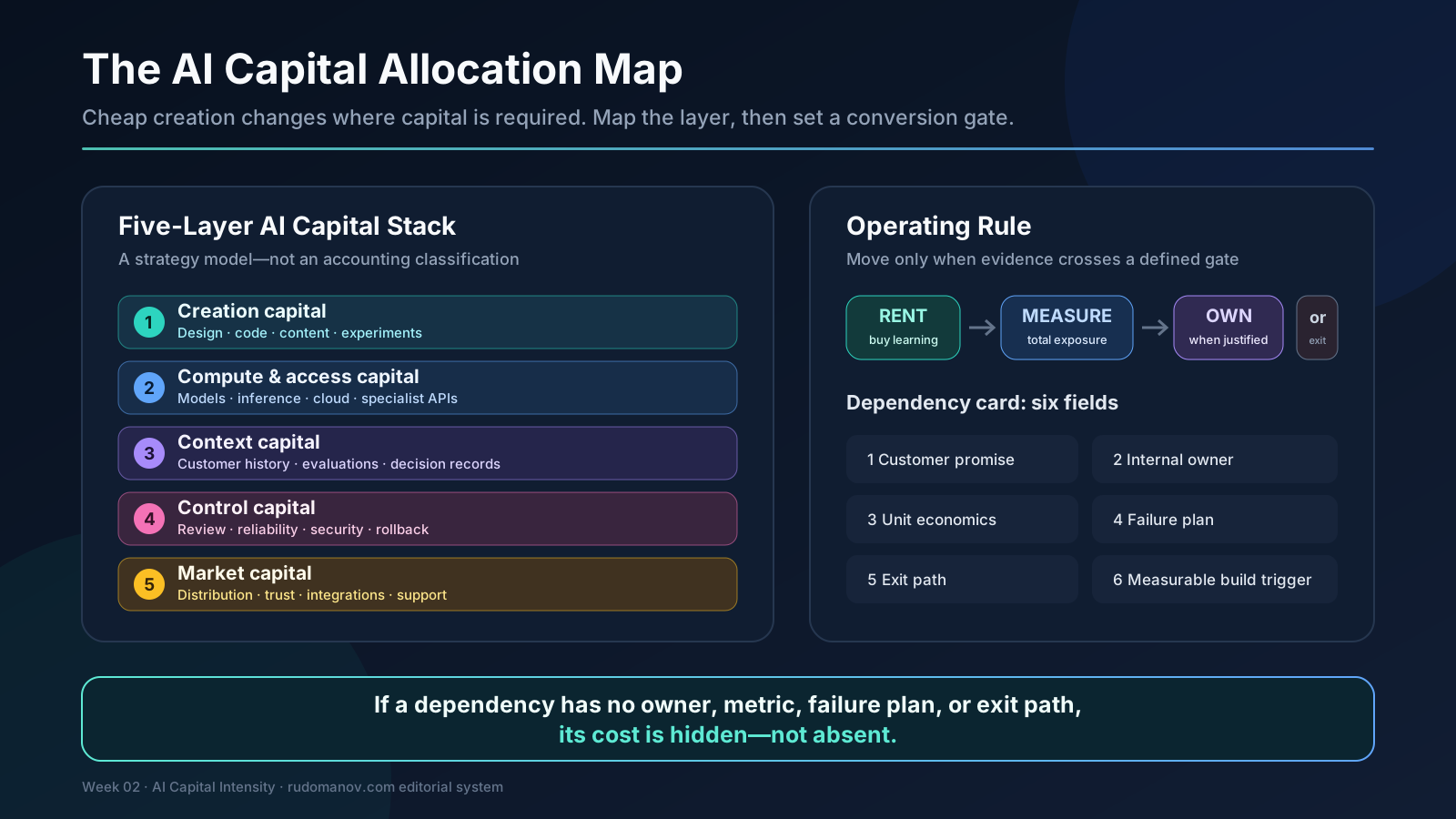
The Five-Layer AI Capital Stack
A practical way to see the shift is to map an AI-native company across five layers. This is a strategic allocation framework, not an accounting classification.
1. Creation capital
Creation capital is the design, code, content, research, and experimentation required to produce an initial capability.
AI has made this layer visibly cheaper. Teams can test more ideas with fewer people and less time. But a company that can launch ten experiments instead of two has not necessarily saved capital if all ten become unmanaged obligations.
2. Compute and access capital
This includes foundation models, inference, cloud infrastructure, specialist APIs, and other externally supplied capabilities.
The important feature is often not the absolute price but the shape of the cost. Common AI API purchasing models are usage-linked, as current provider pricing shows. Cost changes with consumption and product usage. The fixed cost of building may fall while variable exposure rises.
Aggregate vendor spend is not enough to understand this layer. The relevant question is what that consumption buys at the level of a customer, workflow, or completed task. The FinOps Foundation’s guidance on unit economics makes the same general point for technology consumption: relate cost to business-value units rather than reading the bill in isolation.
3. Context capital
Context capital is the proprietary information that makes a general capability useful inside a particular company: customer history, workflow data, evaluation sets, feedback, decision records, and institutional knowledge.
Models can be rented. Context usually has to be accumulated.
This layer becomes strategically important when product quality depends less on access to a model and more on understanding the customer, the workflow, and the standard by which an answer should be judged. A company does not create context capital merely by storing more data. It creates it by turning experience into reusable evidence and better decisions.
4. Control capital
Control capital includes evaluation, human review, observability, reliability, security, governance, rollback, and accountability.
These are not administrative costs added after the product is finished. They are part of the operating product whenever AI output can affect a customer, a transaction, or a consequential decision.
The NIST AI Risk Management Framework treats governance, mapping, measurement, and management as lifecycle activities rather than a one-time launch check. OpenAI’s evaluation guidance likewise recommends explicit criteria and continuous evaluation as systems change.
As generation gets cheaper, generation itself may stop being the constraint. The scarce resource becomes the judgment required to decide what is correct, what is safe, and what is worth shipping.
5. Market capital
Market capital is distribution, customer trust, integrations, support capacity, and the ability to convert capability into durable demand.
AI can increase the supply of software. It does not create a matching increase in customer attention. More products compete for the same budgets, workflows, and trust.
This is the layer most often omitted from claims about cheap creation. A working capability has no durable economics until a company can reach the right users, prove reliability, support adoption, and retain demand. Owning more infrastructure does not solve that problem.
A real allocation decision: integrate instead of build
In one recent platform decision from our operating context, the alternatives were to build, buy, or integrate. We chose to integrate several products built by others rather than recreate those capabilities internally.
The main criterion was speed to ship.
AI had already made it cheaper or faster to prototype, ship, produce content, and analyze the market. But the main deficit was no longer the ability to generate more work. It was human attention to review what AI produced.
That changed the ownership boundary.
If specialist capabilities already exist outside the company, rebuilding each one consumes engineering and management attention that could be applied to selection, integration, review, and customer experience. Integration preserves speed and optionality while requirements are still moving.
But “integrate instead of build” is not the same as “outsource everything.” The external product supplies a capability. The company still needs to own the control points that determine whether that capability belongs in the platform:
- what task it may perform;
- what context it may access;
- what evidence counts as an acceptable output;
- when a human must review the result;
- when the system must stop, roll back, or escalate;
- how the capability can be replaced if the dependency becomes unacceptable.
No quantified outcome is claimed for this decision, and no product or vendor names are needed to understand it. The important evidence is the trade-off: external capability was selected for speed, while scarce review attention made internal control more valuable than duplicating specialist implementation.
Replace build-versus-buy ideology with conversion gates
“Build or buy?” is often framed as a permanent identity choice. AI-native companies need a more dynamic rule:
Rent. Measure. Own.
Rent
Rent or integrate while requirements are uncertain, substitution remains practical, and the capability neither determines differentiation nor creates unacceptable risk.
Renting buys more than functionality. It buys learning before commitment. It keeps fixed investment low while the company discovers what customers actually need.
Measure
Measure total exposure, not only the vendor bill.
For each material external layer, track the unit that matters:
- contribution per customer or completed workflow;
- usage cost relative to value created;
- failure frequency and severity;
- human review minutes per accepted output;
- latency or availability exposure;
- switching work and data portability;
- customer consequences when the supplier changes.
The AWS Cost Optimization Pillar treats cost optimization as an ongoing architectural and operating discipline. The same principle applies here: a dependency cannot be managed from an invoice alone.
Own
Own a layer when repeated evidence shows that control is more valuable than the fixed cost and organizational obligation of ownership.
That may happen because variable cost damages contribution economics. It may happen because failures are too consequential, switching becomes impractical, proprietary context drives differentiation, or a vendor’s roadmap constrains the product.
Ownership should not be the reward for growth or a symbol of technical seriousness. It should be a response to a measured constraint.
Defer
There is a fourth option that build-versus-buy discussions often ignore: do neither.
A capability that has not earned access to capital should be deferred or removed. Cheap implementation is not evidence of strategic importance. When experiments are easy to create, explicit refusal becomes a capital-allocation skill.
The strongest objection: AI companies can be capital-light
The capital-light argument is not wrong.
A company can rent foundation models and cloud infrastructure, use open-source software, integrate specialist products, and operate with a smaller team. Owning the full stack too early can turn uncertain assumptions into payroll, infrastructure, and maintenance obligations. Selective renting can preserve optionality and keep fixed costs low for a long time.
The mistake is turning that observation into a universal conclusion.
AI changes the composition, timing, and variability of commitments. Total capital intensity rises only under identifiable conditions: cheap creation multiplies active products; usage-linked costs scale faster than contribution; proprietary context becomes necessary; or reliability, governance, review, security, and distribution require durable investment.
The distinction from ordinary software procurement is not that AI vendors send invoices. It is the speed at which cheap experiments can become recurring operating commitments before the company has defined ownership gates.
An AI-native company can remain capital-light. It must do so deliberately.
Manage commitments, not just spend
The practical discipline is a layer-by-layer ownership map.
For every material capability, record:
- whether it is owned, rented, integrated, or deferred;
- the business unit by which its value and cost are measured;
- the human owner of the decision;
- the review cadence;
- the condition that would trigger redesign, ownership, replacement, or removal;
- the exit path if the dependency becomes unacceptable.
Not every layer should eventually be internalized. Compute may remain rented while context and control are owned. A specialist product may remain integrated indefinitely if it remains replaceable and economically sound. Market capital cannot be acquired merely by moving infrastructure onto the balance sheet.
The deeper shift is from managing production capacity to managing commitments.
When creation was expensive, the main question was often: can we build this?
When creation becomes cheap, the harder questions are:
- Should this exist in the portfolio?
- Who will review and operate it?
- Which dependency can we tolerate?
- What evidence would justify owning it?
- What will we stop funding if the evidence never arrives?
The board-level question is not “How much headcount did AI remove?”
It is: Which obligations grew because creation became cheap, and which of them deserve durable capital?
Which rented layer in your AI stack has a defined conversion gate—and which one is becoming a permanent commitment by default?