Delegating execution increases output. It removes founder dependence only when the company also delegates bounded authority: who may accept evidence, make a commitment, handle an exception, and reverse the decision.
A founder can delegate almost every task and still remain the company’s main bottleneck.
Research moves to an analyst. Code moves to an engineer or agent. A release is prepared by an operator. Customer communication is drafted by AI. The work appears distributed, yet every uncertain result returns to the founder for approval.
The organization has scaled production without scaling judgment.
This distinction matters more as AI makes execution faster. When people and agents can produce more options, code, analysis, and content, the queue does not disappear. It moves to the point where someone must decide whether the work is good enough, safe enough, economical enough, and aligned enough to become a commitment.
If that person is always the founder, delegating more tasks can make the bottleneck worse. More output creates more requests for review.
The founder-as-architect move is not to approve less by default. It is to design which decisions can proceed without the founder, inside what limits, with what evidence, and with whose accountability.
A task is not the same as a decision
Task delegation answers one question: who will do the work?
Decision delegation answers a harder set of questions:
- Who may define or change the scope?
- Who decides that the evidence is sufficient?
- Who may spend money, expose customer data, or make a customer promise?
- Who may release the result?
- What exception forces escalation?
- Who may pause or reverse the commitment?
A founder who delegates the task but retains all six rights has not delegated the consequential part of the work. The task travels outward. The right to decide snaps back.
This is why activity metrics can mislead. The number of delegated tickets, agent runs, drafts, or pull requests says little about organizational independence. A more useful question is: where does completed work wait?
Suppose an AI-assisted system prepares a software change. It can write code, run tests, summarize the diff, and recommend a release. Production is fast. But if only the founder can interpret the evidence, accept the residual risk, authorize deployment, and decide what to do if the release degrades service, the company still has one commitment queue.
This is a hypothetical mechanism, not a claim about a particular company. It illustrates the difference between producing an artifact and authorizing its consequences.
Locate the bottleneck at the commitment point
Most work crosses at least two boundaries.
The first is a production boundary: an artifact is created. The second is a commitment boundary: the organization acts on it.
A market analysis becomes a budget allocation. A prototype becomes a supported product. A draft becomes a public statement. A code change becomes a production release. An agent recommendation becomes an action with financial, legal, operational, or customer consequences.
The founder bottleneck usually sits at the second boundary.
That does not make founder review irrational. A founder may hold the densest strategic context. The company may lack another owner with enough experience to judge an unfamiliar risk. Some decisions are rare, expensive to reverse, or formative enough that retaining founder authority is correct.
The problem begins when every decision inherits that logic, including recurring decisions with stable criteria and limited exposure. “The founder has more context” becomes a permanent substitute for designing ownership.
To find the actual bottleneck, map one recurring decision class from request to reversal. Do not begin with the org chart. Follow the decision:
- Who may request the work?
- Who or what executes it?
- Who defines acceptable evidence?
- Who may turn the result into a commitment?
- Which exceptions escalate, and to whom?
- Who may stop or reverse it?
- What happens when the designated approver is unavailable?
The last question is especially revealing. If no one knows whether the decision should proceed or wait, the company does not have a delegation system. It has a dependency on availability.
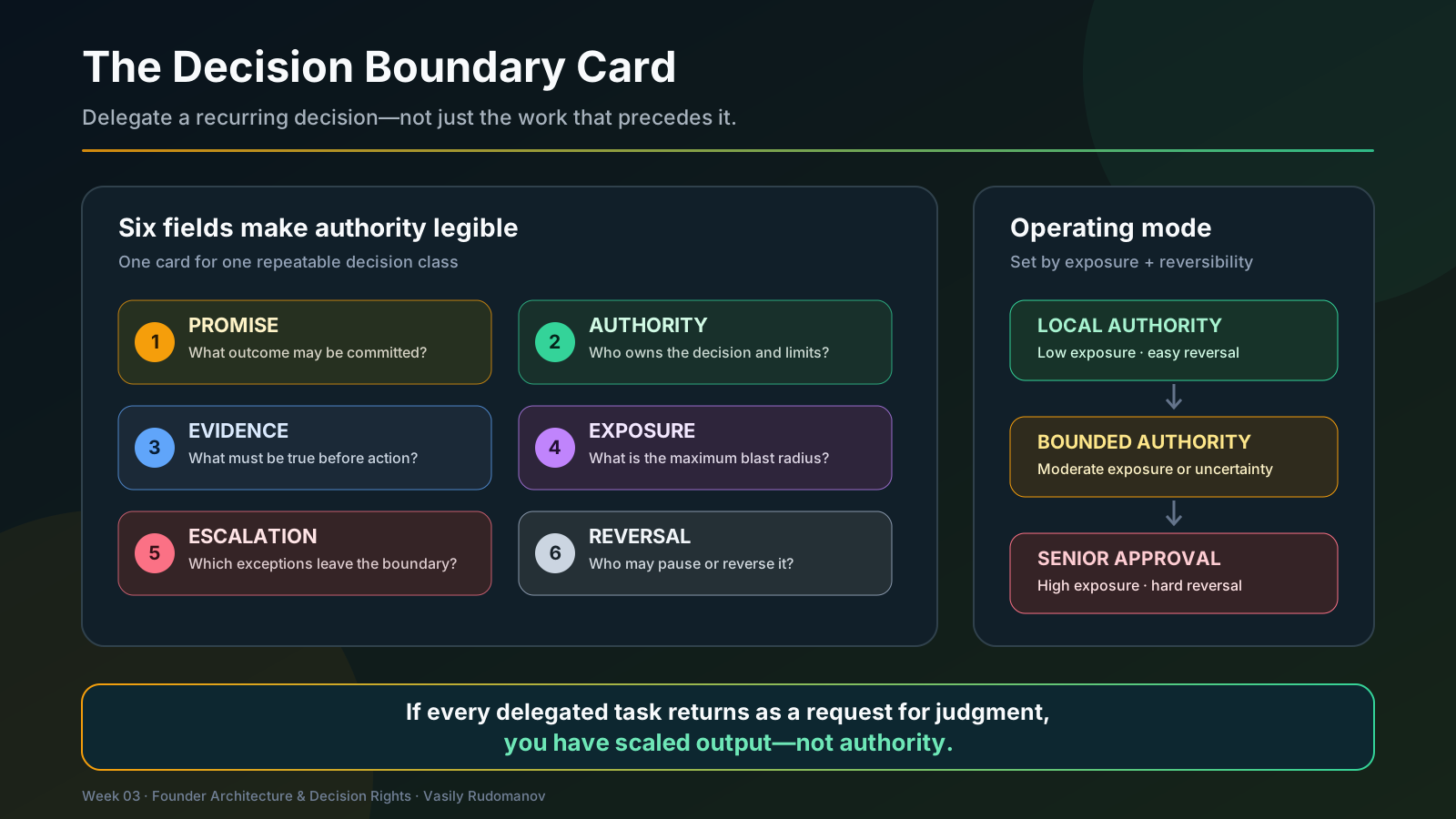
The Decision Boundary Card
A useful delegation rule should be lighter than repeated founder approval. For one recurring decision class, write a Decision Boundary Card with six fields:
1. Promise
What outcome may be committed, and to whom?
Separate permission to produce work from permission to make a promise. An operator may be allowed to prepare a campaign without being allowed to commit spend. An agent may draft a customer answer without being allowed to send it. An engineer may prepare a release without being allowed to expose all customers to it.
2. Authority
Name the human decision owner, the execution delegate, and the limit of each role.
“The team owns it” is not precise enough. Neither is “the agent decides.” A named human owner must be able to explain the decision, inspect the evidence, and carry the responsibility for acting within the boundary.
GitLab’s public handbook describes a directly responsible individual as the person ultimately accountable for a piece of work or decision. That model does not prove a universal performance benefit, but it captures an important operating principle: contributors can be many while final ownership remains legible.
3. Evidence
What must be true before the owner may commit?
Evidence can include tests, evaluation results, security checks, cost estimates, source records, review logs, or a comparison with an agreed baseline. The right evidence depends on the decision class.
For model-enabled systems, OpenAI’s first-party guidance on evaluation best practices recommends task-specific evaluation criteria and continuous evaluation as systems change. The broader lesson is not that evaluation makes a decision automatic. It is that authority becomes safer when “good enough” is made observable before an exception occurs.
4. Exposure
What is the maximum acceptable blast radius?
Bound the relevant dimensions: budget, time, tool access, data access, customer reach, transaction size, duration, and operational consequence. Local authority can usually be wider when exposure is small and reversal is practical.
For software releases, Google’s canarying guidance offers one concrete mechanism: expose a change to a limited population, compare observed signals, then continue or roll back. Not every business decision is a software canary, but the design principle travels well. Limit the first commitment so evidence can be gathered before exposure expands.
5. Escalation
Which signals move the decision outside the local boundary?
Examples include an untested condition, a budget overrun, conflicting evidence, sensitive data, a material customer consequence, or an unavailable rollback path. Name the escalation owner and define a fallback or timeout rule. Otherwise an absent approver becomes an accidental stop condition.
6. Reversal
Who may pause or reverse the decision, under what trigger, and what record must be preserved?
Reversal rights are part of delegation, not evidence that delegation failed. A boundary is credible when the organization can contain a bad decision, inspect what happened, and narrow or redesign the authority without reconstructing the event from memory.
The NIST AI Risk Management Framework treats governance, measurement, and management as lifecycle activities rather than a single approval before launch. It is not a startup delegation playbook, but it reinforces the underlying point: accountability must persist after an initial decision.
A one-page operating template
The card can stay short:
- Decision class:
- Promise allowed:
- Named owner:
- Execution delegate:
- Authority limit:
- Required evidence:
- Exposure limit:
- Escalation trigger:
- Fallback if the approver is unavailable:
- Pause or rollback owner:
- Review date:
- Observable signal:
The unit of delegation is not an isolated task. It is a repeatable decision class with a boundary.
One card should remove repeated bespoke approvals. If the card creates six new meetings, it has reproduced the bottleneck in process form.
Delegate by exposure and reversibility
Not every decision deserves the same architecture. A practical gradient is:
Low exposure, easy reversal, stable criteria: keep authority local. The named owner can proceed when the required evidence is present.
Moderate exposure or uncertain evidence: use bounded authority. Limit spend, access, reach, or duration; inspect the result at an agreed review point.
High exposure, difficult reversal, immature criteria: retain founder or designated senior approval until the company understands the decision well enough to define a safer boundary.
This is a reasoning aid, not a universal risk matrix. The important move is to explain why a decision belongs in one category and what evidence would allow it to move.
Reversibility alone is not enough. A technically reversible change can still damage trust. A small financial commitment can create a large legal precedent. Exposure must be defined in terms of the promise the company is making, not just the implementation step.
The strongest objection: founder centralization can be correct
In an early company, the founder may be the only person who understands the strategy, customer context, cash constraints, and consequences at the same time. Formal decision rights can create false confidence. Delegating approval before another owner has developed judgment may distribute authority without distributing competence.
Process also has a cost. A small team can spend more time documenting boundaries than making decisions. Founder review may be faster than a governance system for rare or novel commitments.
These objections should change the design, not be dismissed.
The goal is not to remove the founder from every consequential decision. Keep founder judgment where downside is material, criteria are immature, or the decision shapes the company itself. Reduce the active portfolio if there are more initiatives than the organization can responsibly govern. Revoke a boundary when observed failures exceed what the company can tolerate.
But centralization should be an explicit choice by decision class, not the unexamined default for all work.
The difference is testable: does this decision wait for the founder because the downside truly requires founder judgment, or because no one has written the conditions under which another owner may proceed?
Measure the boundary, not the rhetoric of autonomy
A delegation system should earn wider authority through evidence.
Start with one recurring decision class:
- Document the current owner and where work waits.
- Write the six fields of the Decision Boundary Card.
- Run the boundary inside a limited exposure window.
- Observe waiting time, rework, escalations, escaped problems, and reversals.
- Review both the outcomes and the quality of the evidence used.
- Widen, retain, narrow, or revoke the boundary.
No universal numerical threshold can decide this in advance. A rollback in a low-risk internal tool and a failure affecting customer funds do not belong in the same denominator. Measures need a defined period, decision class, and consequence.
The objective is not maximum autonomy. It is the smallest amount of centralized judgment consistent with the promise and exposure.
Architecture is what proceeds without you
A founder becomes an architect by making authority legible.
That means deciding where judgment must remain concentrated and where it can be converted into a repeatable boundary. It means naming an owner, defining evidence, limiting exposure, anticipating exceptions, and assigning reversal rights before the founder becomes unavailable.
If every delegated task returns as a request for judgment, the company has scaled output—not authority.
The transition is incomplete wherever safe progress depends on the founder being continuously present. The measure of the architecture is not how much work others perform. It is whether the right decisions can proceed, the wrong ones can be stopped, and the consequences still have a named human owner.
Which recurring decision in your company still waits for the founder because the downside truly requires founder judgment—and which one waits only because no boundary has been written?